
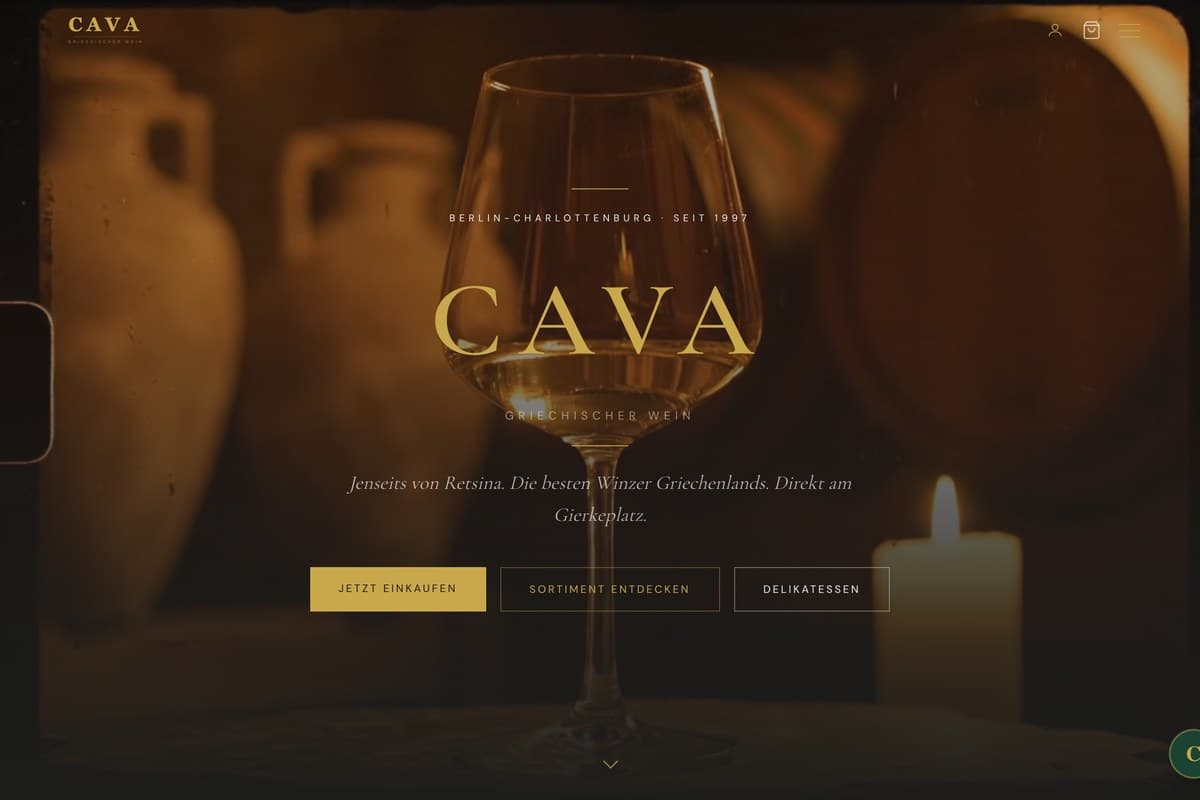
CAVA Griechischer Wein has poured Greek wine into Berlin-Charlottenburg since 1997. When Manolis Saxonis handed me the brand, the brief was easy to say and hard to build: take a family wine merchant and make it look — and work — like a house with global ambitions.
The scale nobody expects from a wine shop
The catalogue is the first thing to break naïve assumptions. CAVA carries 316 products as of 28 May 2026 — wines, spirits, olive oil and delicatessen — organised across 32 winery categories and ten Greek regional filters. A customer can arrive knowing only “something from Naoussa” and leave with a specific bottle in their cart. That only works if the catalogue is structured, fast and searchable, not merely uploaded.
So the store had to feel effortless while carrying real depth. Every product page does the unglamorous work too: unit price per litre, alcohol by volume, the sulfite notice — the details that make a wine shop trustworthy and lawful at the same time.
Headless, on purpose
CAVA runs on a headless architecture: a Next.js frontend on Vercel, with Shopware 6 as the commerce backend on German servers. The shop logic — catalogue, cart, checkout, tax — lives in Shopware, where it belongs. Everything the customer sees and feels is rebuilt in Next.js, where I have full control over speed, layout and language.
Headless is more work up front. It is worth it for three reasons: performance, because the frontend ships only what each page needs; flexibility, because the design is never hostage to a theme system; and ownership, because the brand is not trapped inside a template someone else controls. Email runs through Resend. Analytics is Vercel Analytics — cookieless by design.
Six languages, one identity
CAVA speaks six languages: German, Greek, English, French, Italian and Spanish. The choice is remembered in a single cava-locale cookie, so a returning visitor lands in their language without fighting the site. Greek wine is a diaspora product as much as a German one — the languages are not decoration, they are the market.
Christos, the sommelier who never sleeps
At /sommelier there is Christos, an AI sommelier powered by Anthropic Claude. He recommends bottles the way a good shop assistant would — by taste, occasion and food — across all six languages. The processing happens in the US, and the policy says so plainly. Transparency is not a footnote here; it is the design.
A map of where the wine comes from
The Weinland map at /weinland places the wineries on an interactive Mapbox map, so the regions stop being abstract names. Where Google Maps loads nearby, it does so only after a clear two-click consent — no third-party scripts run behind the customer’s back.
Compliance as a feature, not a tax
German e-commerce law is unforgiving, and that is fine — it is the same rulebook for everyone, so meeting it well is an advantage. CAVA sets only technically-necessary cookies (cava-locale and sw-context-token). Age verification is handled in localStorage. There are no tracking cookies. The unit price and ABV sit on every product under the PAngV, and the “Enthält Sulfite” notice is never missing. Payment is Vorkasse — bank transfer — per the AGB.
Performance is part of the duty, not the flourish: measured cookielessly, served fast, without forcing scripts on the visitor that they do not need.
“Built with Manolis Saxonis. He trusted me to deliver what others said wasn’t possible at this scale.”
— Dimitrios
Go deeper